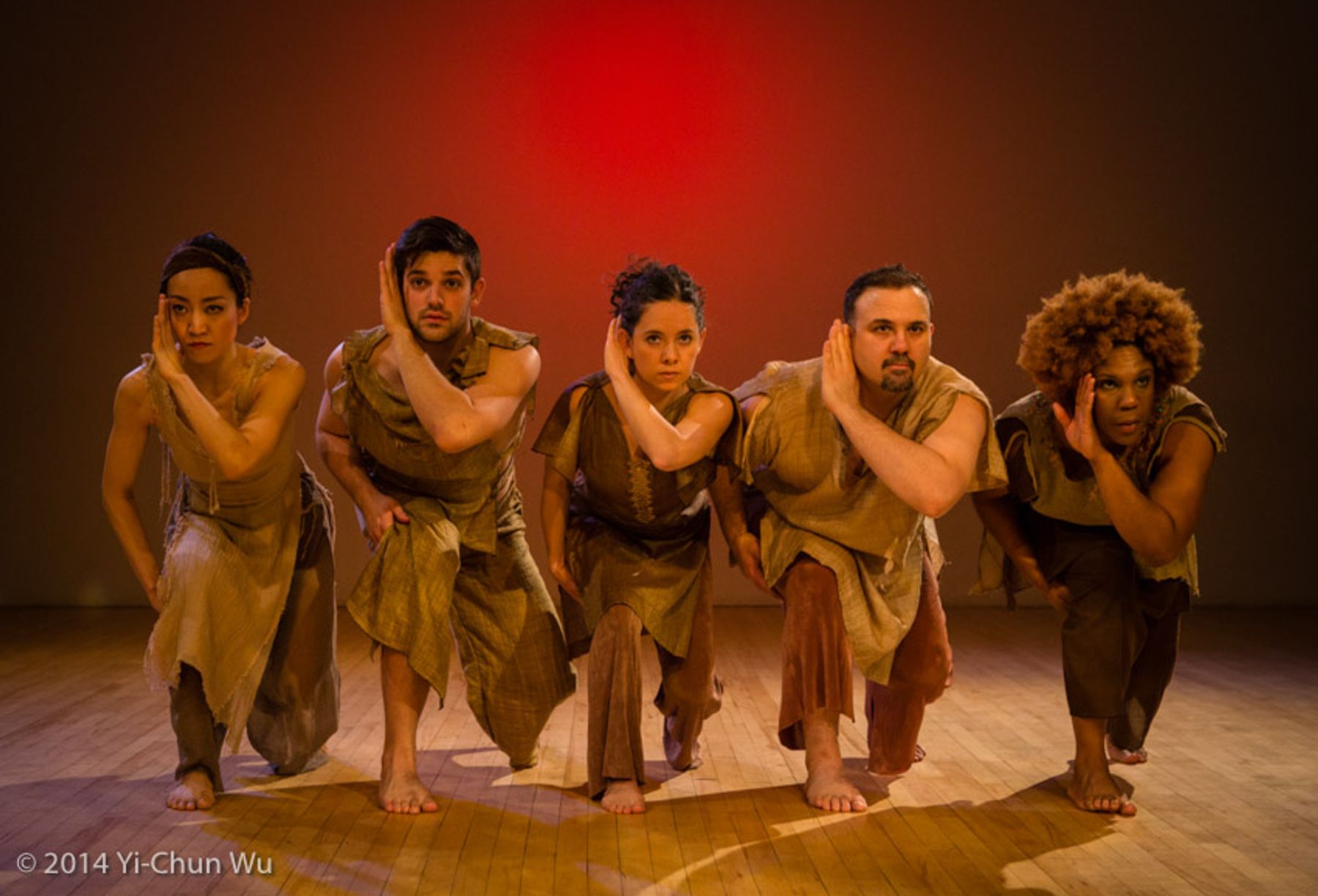
“ SASHA SOREFF DANCE THEATER April 12, 2014 “What is sacred to you right now?” inquired the program notes of Sasha Soreff’s Hineni. Premiered at the Performance Project at University Settlement only a few days prior to Passover, the title, Hebrew for “Here I Am,” calls for a particular presence from its audience to both bear witness and contribute to an intergenerational study on the idea of a calling and the myriad of routes one can take to reply. For an hour, we peer on vignettes of modulating emotional intensity, connected spatially by a diagonal trailing upstage left. What could possibly lie beyond is as variable as each dancer’s response to the pathway. Three young guest artists from The Door take the first steps. Their methodical crawls from downstage right make the space seem miles long. They effortlessly pass a pool of light, but Soreff’s dancers all struggle intensely. Are the youngin’s oblivious to a present calling, or are they following a more instinctive signal farther off? Regardless, the work consistently affirms “the kids are alright.” The first time the entire cast is onstage is the first time the diagonal disappears. They all seem to navigate their own diagonals, proclaiming their presence to themselves alone. After reinstating, it disappears again the first time the cast looks at us directly from a more visually dominant horizon upstage. This relationship of first times with a distorted path is subtle but symptomatic of the increasing ambivalence of Jeanette McMahon’s disembodied voice: “My leap of faith is not yours for the taking.” We meet Calling’s neurotic twin, Compulsion. Soreff’s company is an incredibly mixed bag. Desira Barnes’ focus is so full you experience it vicariously to watch her. Ryan Leveille is a generous partner and an agile soloist. Nathan Duszny’s dance moves look too much like dance moves for the work, but he executes them with a raw honesty. You can hardly tell Mika Yanagihara was a Graham dancer when she speaks Soreff’s softer vocabulary; her dramatic intensity gives her away. Ana Romero, a newcomer, has a trustworthy stage presence, providing a grounding that allows these disparate dynamics to harmonize consonantly to Yoav Shemesh’s rich score. It ain’t over ‘til the entire audience takes a comp class. The program’s questions were not rhetorical. The piece halts; Soreff leads a discussion about our criteria for sanctity, astutely bringing awareness to and translating body language as choreography. The audience catches on. More speak up in the hopes that their, at this point, eagerly pre-choreographed gestures will be made into art, but art isn’t the point. After a small phrase is made, we travel with these movements on the diagonal that shapes the entire journey. The goal of Soreff’s art is real, hands-on community engagement. Her residency is doing (and accomplishing) highly necessary work – making dance accessible to laymen without dumbing it down. We dive into the frame yet can keep our discoveries once we emerge. EYE ON THE ARTS, NY -- Jonathan Matthews ” - Jonathan Matthew
“Everyone manages moments of adversity differently. For Jewish choreographer Sasha Soreff, a community dance project is the ideal approach. Premiering on Wednesday night in New York City, Soreff’s interpretive dance performance Hineni—Hebrew for ‘here I am’—combines biblical stories with modern examples of struggle. Each performance will be followed by an audience discussion led by various faith leaders, rendering the Jewish-inspired artwork accessible for the community at large. Inspired by a tattoo of the word hineni she once saw on a dancer’s ankle, Soreff set out to create a dance that would be deeply rooted in Jewish tradition yet meaningful to a wider audience. She studied the 26 times the word hineni is used in the Tanach and attended a class on Jewish and Muslim exegetical texts that examined the stories of Abraham and Moses. Soreff also studied early childhood development to understand the stage at which man is most likely to take responsibility and be moved to action. The project progressed when she met Israeli composer Yoav Shemesh through Asylum Arts, an organization that connects artists interested in exploring Jewish culture. Hineni’s debut marks exactly one year since the two artists met and decided to collaborate, with Soreff choreographing and Shemesh composing an original score for the piece. Notably, none of Hineni’s dancers are Jewish. Soreff, who grew up in a Conservative Jewish household and is a member of a synagogue in New York, explained that the performers feel personally connected to the piece even though its foundational stories are Jewish. Dancers will be joined onstage by participants in The Door, the University Settlement’s program for at-risk youth. Certainly, the dance will appeal to Jews in the week leading up to Passover, where they will recount the story of the Jews’ exodus from Egypt and the 40 subsequent years traveling through the desert. But Soreff insists that the performance’s interpretations of scenarios like the binding of Isaac, or Moses at the burning bush, are for more than just Jews: “What does it mean to be called upon? How do we respond? Everyone can contribute to that conversation, regardless of their faith, or lack thereof.” Hineni runs April 9 through 12 at 7:30 p.m at the University Settlement. You can buy tickets here.” - Lily Wilf
— Tablet
“ Sasha Soreff Dance Theater and Gad's Hill Theater Company present the new theatrical dance event, The Dancer Who Wore Sneakers and other tales, by Sasha Soreff. The performance fuses dance and theater to create a new work. Dancers carve, lift and tumble each other through space while other cast members bring the narrative to life. Sneakers takes place in a world where people are only able to take a certain number of steps per day. This precludes them from dancing. Sneakers protect Ms. Soreff, playing the main character, from injury. Upon the opening of the show, a pair of red and white tennis shoes lay center stage. The large cast of 25 dancers enter and remove their shoes and exit. Already a symbolic, baptismal air fills the stage as the audience is left wondering why this happens. Clothed in differently styled beige colored clothing, the dancers look like skin in costumes by Dawn Marococcia. This neutral tone creates a backdrop for all the events to come. The music is a soft piano. Two dancers, one being Ms. Soreff, begin to move together, carving the space in connecting patterns. An unidentifiable image appears on the backdrop screen and, like adding pearls to a neckalace, dancers enter from stage left, moving low as if working through a moving meditation. All of Ms. Soreff's movement has a yogic quality. She's not afraid to slow movement down and fill it with breath. Events change a bit too abruptly as a theatrical incident begins downstage. It is discovered that this man has broken a law and has "really done it this time." Throughout the show, bits of this man, Smedly's, story and others like him are revealed in scenes like this one. The show follows a repetitive format. A cycle that includes a scene by the actors, the dancers carrying a person who is unable to touch the ground across the stage, Sasha and another dancer performing a duet, and a response by the chorus. While this format keeps things changing, it is too quickly discovered and anticipated by the audience. The chorus of this piece is what makes it beautiful. Just like the chorus of a classic Greek tragedy, they move with one mind and many bodies, carrying the emotional weight of the show. Their limbs cascade like bird wings. Dancers carry another dancer all the way across the stage, leaving tangible images of bodies tumbling through space in slow motion. Ms. Soreff's dancers move in luscious gymnastics. The music repeats the same drum and piano meditation several times throughout the piece. This is the main music for the piece, composed and produced by Matt Stine and Cody Owen Stine. Near the end, it is satisfying to hear live drummning alongside recorded music. As the plot continues, Smedly runs away and meets Wilma, a woman looking for "the canyons." Along the way, Smedly and Wilma meet other wayfarers. The dialogue is crisp and effective. In "the canyons," people may take as many steps per day as they wish, which translates into being able to dance. The plot examines the nature of injuries, specifically injuries for dancers, and also laces the performance with political ideologies including communism and Nazism. Perhaps the most fun and interesting portion of the performance is the clash of the body parts. The chorus stands around the ring wearing different signs such as "neck," "foot," and "hip" indicating which dancer they are rooting for. Dancers representing these body parts enter the ring and perform a striking post-modern style fight. The fighting winds down to Sasha and her usual dance partner who, in a moment of dramatic impact, recognize eachother from their earlier encounters. The piece climaxes as all cast members are onstage with Wilma and Smedly, who are finally able to dance. All cast members dance in jubilant triumph, signifying their freedom. Alaine Handa, a dancer in Sneakers, comments on working with Ms. Soreff. "She is really patient and really specific." Alaine says that Ms. Soreff would give the dancers a phrase and sometimes ask them to change it or tweak it in certain ways. Through this process Aliane learned to "watch each other, watch each other, watch each other." She hopes members of the health and wellness community will see how the themes about injuries in Sneakers relate to the medical field. Sasha Soreff Dance Theater and Gads Hill Theater Company present: The Dancer Who Wore Sneakers By Sasha Soreff The Ailey Citigroup Theater December 2nd, 3rd, and 4 th. 405 W 55th St. at Ninth Avenue Tickets: 212-501-2425 http://www.brownpapertickets.com ” - Molly Holm
— TheaterScene.net